Type "why is this so beautiful" into any search bar and, sooner or later, someone will whisper two words back at you: sacred geometry. 🔯 It sounds like incense and crystals. It's actually closer to plumbing — the hidden pipework that quietly carries beauty from one great image to the next.
Here's the thing nobody tells you up front, so I will, with affection: a huge amount of "sacred geometry" online is gorgeous nonsense — overlaid spirals slapped on the Mona Lisa to prove a point the painter never made. 😅 But buried inside the nonsense is something real, ancient, and genuinely useful — a small set of proportions and patterns that show up in shells, cathedrals, tile floors, and the painting you can't stop looking at. Let me show you who first heard the math humming, why it spooked an entire brotherhood, and — most importantly — how you can borrow the good part for your own work by tonight.
🔯 The man who heard the universe doing arithmetic
Twenty-five centuries ago, on a Greek island, a thinker plucked a string, shortened it by half, and heard the note jump exactly one octave. Halve it again — another octave. Whole-number ratios, he realized, didn't just describe the music. They were the music. From there he made a leap that still echoes: if number rules sound, maybe number rules everything. 🌌
There is geometry in the humming of the strings, there is music in the spacing of the spheres.
— Pythagoras (c. 570–495 BCE)
Read that twice, because it's the whole thesis of this post in one breath. Pythagoras is saying beauty isn't decoration laid on top of the world — it's structure leaking out of it. The pleasing curve of a shell, the chord that makes your chest ache, the way a great composition just sits right — same source, different clothes. Number, wearing a hundred disguises. 🎵
🔮 Plot twist: Pythagoras didn't run a math class — he ran a secret, cult-like brotherhood with genuinely bizarre rules. New members took vows of silence for years. Property was shared. And — most famously — you were forbidden to eat beans. 🫘 They believed whole numbers were literally divine, that the cosmos itself was secretly number, clean and rational all the way down. Then one of their own, a man named Hippasus, proved that √2 — the diagonal of a simple square — cannot be written as any fraction. An "irrational" number, a thing the universe shouldn't contain. It broke the entire faith. And legend says the brotherhood was so horrified that they took Hippasus out to sea and drowned him. 😶 The founder of rational mathematics may have had a man killed over a number that refused to fit the pattern. Beauty, it turns out, has always had a body count.
Wait — the guy who basically INVENTED "the universe is math" had someone drowned for finding a number that didn't behave?? 🤯 And the number was just… the slanty line across a square?! I drew that in second grade! That genuinely rattled me. I always thought math was the calm, safe part of beauty. Turns out it had a cult, a snack ban, and a murder.
📐 The golden ratio: real, overhyped, and still worth stealing
Here's the pattern under the pattern — and once you can name it, you'll see it everywhere. 👽
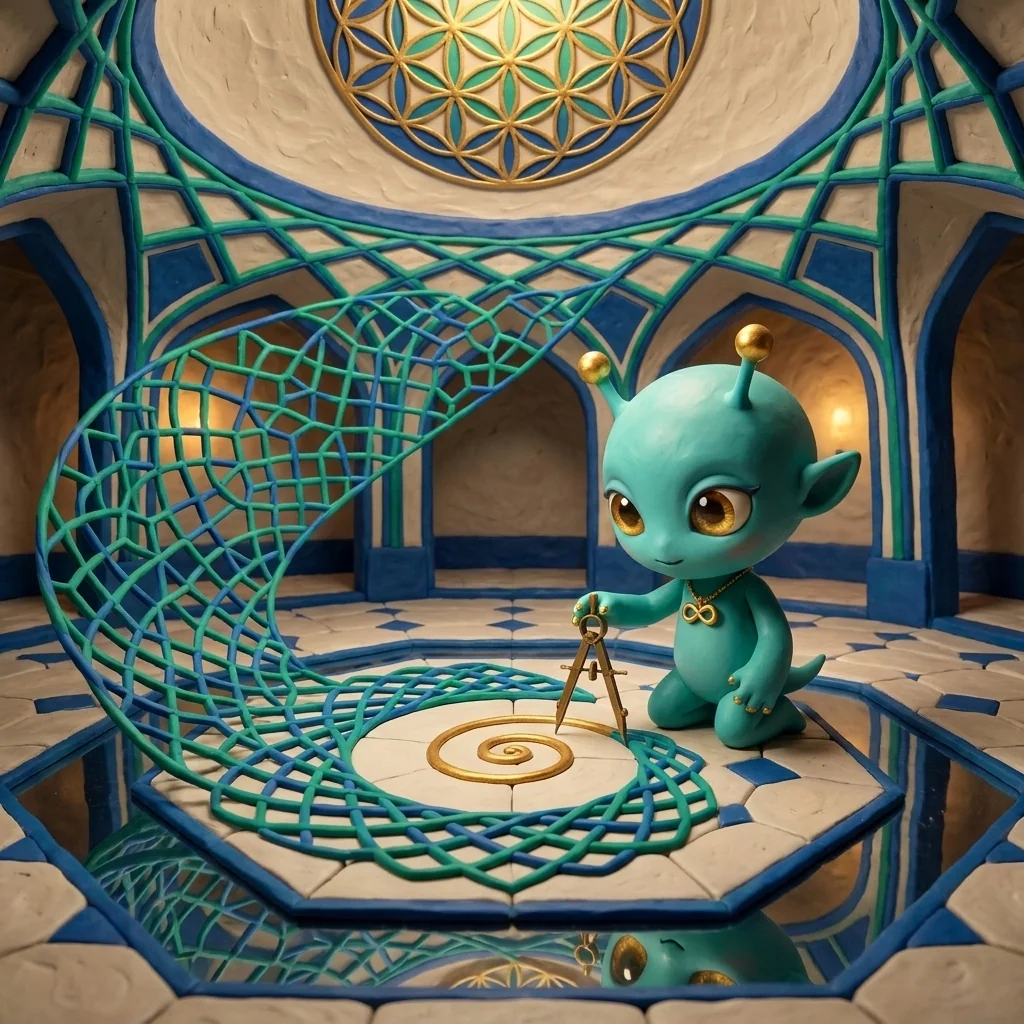
Let me be precise, because this is where the internet gets sloppy. The golden ratio — roughly 1.618, the number where the whole relates to the larger part exactly as the larger part relates to the smaller — is real, and it genuinely recurs in nature: sunflower seed-heads, nautilus shells, the branching of leaves. That part is not mysticism; it's growth math. What's overhyped is the claim that every old master secretly ruled their canvas with it. Most didn't. But here's the truth that survives the debunking: artists don't need the number — they need the feeling the number produces. A proportion where no part is exactly half, where the eye keeps moving instead of settling dead-center. Same delight, reached two ways. The mystics found it by faith; the masters found it by squinting until it looked right. The math was just describing what the eye already loved.
This is why "is the golden ratio real in art" is the wrong question, slightly. The number is real. The conspiracy is mostly invented. But the underlying principle — that off-center, unequal, nested proportions are more alive than symmetrical, halved ones — is bone-deep true, and you can use it without ever doing a single calculation. 📜 The compass was never the point. The compass was just one way of listening to what Pythagoras heard in the string.
🏘️ Why tiled floors and clay tiles run the same math
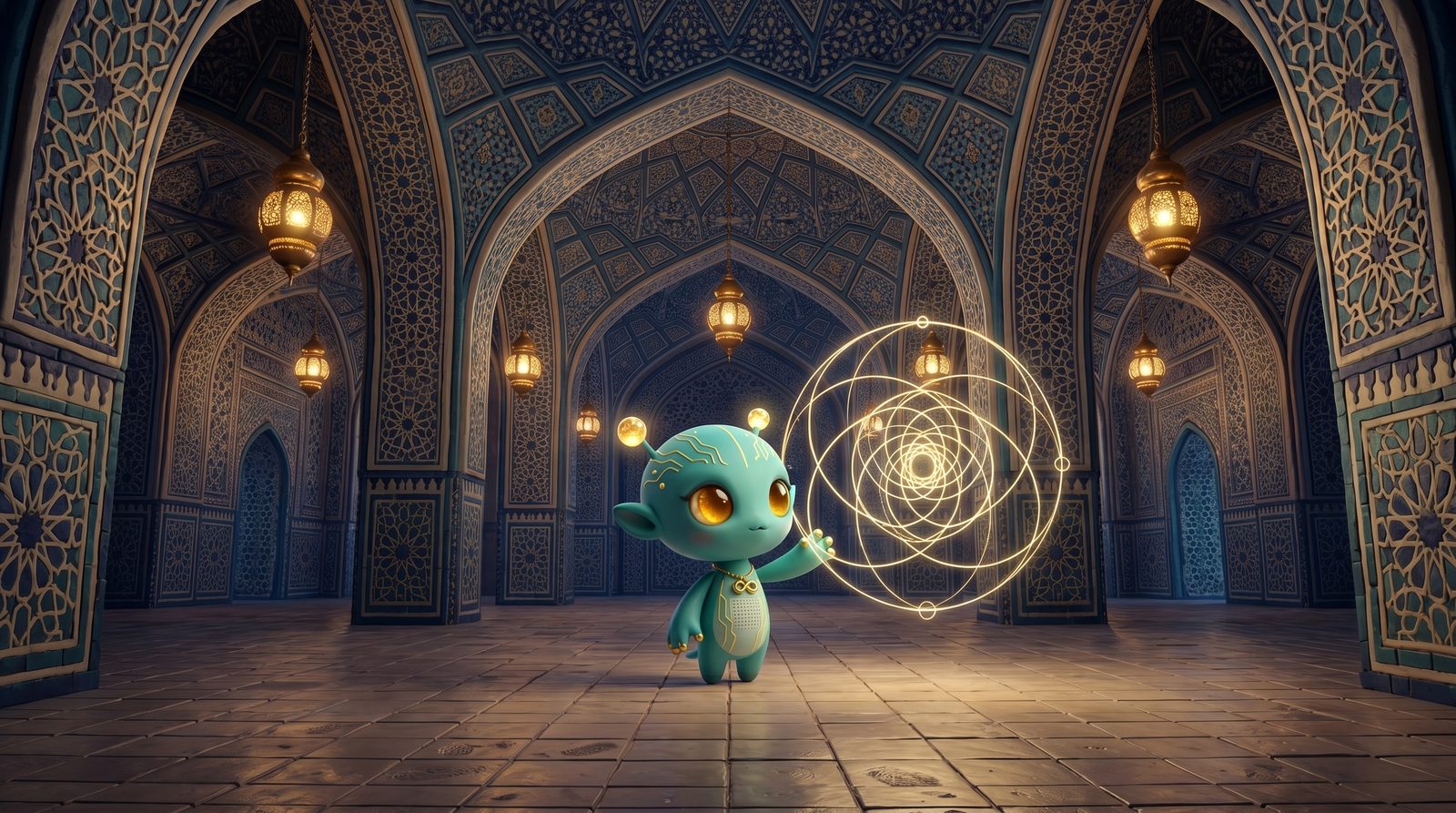
Look at the most patient pattern-makers in history — the people who tiled the great domed halls — and you find Pythagoras's idea made walkable. 🕌
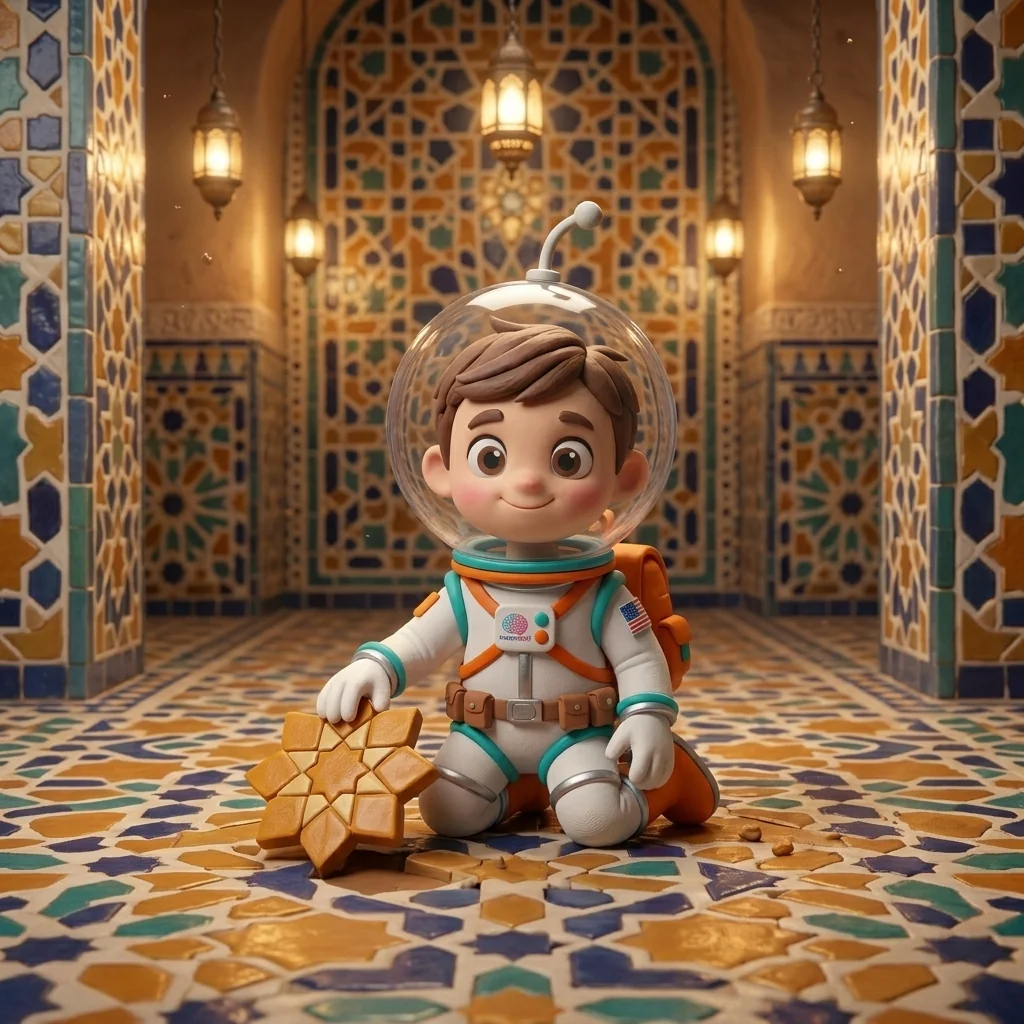
The craftsmen who laid girih tilework didn't think of themselves as mathematicians, but they were doing something Western math wouldn't formalize until the 1970s: tiling a surface so it extends forever and never exactly repeats. Decagons, pentagons, bowties, kites — interlocking by rule, laced together by a single unbroken strapwork line, star into star into star. Number as architecture. Number as devotion. The same impulse that made Pythagoras gasp at a string, made an anonymous tile-setter spend a year on a floor you could pray on. 🌀
This is the part the Village loves most. 🌟 Pattern isn't a flex — it's a welcome. A tessellation says: there's a place for the next tile, and the next, and the next, forever, none of them more important than another. That's not just geometry; that's how a community holds. We build our whole world on shared rules that let endless different pieces lock together and still make one floor. You don't need to be the center of the mandala. You just need to fit the pattern — and the pattern was always big enough for you.
🪞 You already feel the math — you just never named it
Here's the quiet test that proves sacred geometry lives in you, not just in textbooks. 👀

Picture any image that's ever stopped you — a photo, a painting, a single frame of film. 🎬 Now notice where the thing that matters sits. Almost never dead-center. It's off to one side, about a third of the way in, with breathing room pulling your eye across the frame. That tug you feel — that sense of "yes, there" — isn't taste you were born with. It's proportion. It's the off-center, unequal, golden-ish balance your eye has been quietly trained to love since the first cave wall. You've been reading sacred geometry your whole life. Nobody handed you the manual. Today I'm handing you the manual.
💡 What to do today
Open any photo on your phone — or sketch one rough box on paper. Now divide it into thirds, both ways, like a tic-tac-toe grid. 🎨 Move your subject off the center and onto one of the four points where the lines cross. That's it. That's the rule of thirds — the training-wheels version of the golden ratio, and it works almost every time. Take the same shot centered, then thirded, and feel the difference: one sits there politely, the other comes alive. You just used 2,500-year-old math without doing any arithmetic. 🌱
If you want to actually feel why it works — to play with proportion and pattern hands-on instead of just reading about it — Brilliant runs a lovely interactive course on the geometry of patterns: an interactive geometry and math-of-patterns course (affiliate link — coming soon).
And if you'd rather curl up with the deep version — the full strange history of the golden ratio and sacred geometry in art — this is a beautiful companion: a book on sacred geometry and the golden ratio in art (affiliate link — coming soon).
📐 The equation: Number × an attentive eye = beauty you can feel before you can explain.
🕊️ The same idea lives in the collection
This is, quietly, how Turbomindz is built. Every universe in the collection runs on its own pattern and proportion logic — a hidden grammar of geometry, palette, and rule that holds the whole world together, exactly the way one strapwork line laces a thousand tiles into a single floor. 🏛 The Geometric Sacred hall you've been walking through in these images is one of those universes, made of pressed clay polygons that tile outward forever. None of it is decoration laid on top. It's structure leaking out — the same thing Pythagoras heard in the string. If you'd like to feel that math turning, the collection is right there: no countdown, no pressure, just patterns built to be lived inside. 🏘️
she sets the compass down on the tile, and the line it drew keeps going on its own, out past the edge of the floor, looking for the next star to lace.
🙋 Frequently asked
What is sacred geometry? Sacred geometry is the old idea — running from Pythagoras through Islamic tilework to Gothic cathedrals — that certain proportions, shapes, and patterns (the circle, the golden ratio, the Flower of Life, repeating tessellations) carry a built-in sense of harmony, as if number were the secret language of the world. Stripped of the mysticism, the useful core is simple: specific mathematical relationships consistently feel beautiful and balanced to human eyes, so artists and architects have used them for thousands of years to organize images and buildings.
Is the golden ratio real in art? Yes and no — and the honest answer is more useful than either myth. The golden ratio (~1.618) is a real number that genuinely appears in nature, like sunflower heads and shells. The popular claim that every old master secretly used it to compose is mostly overstated; most didn't measure anything. But the principle it describes — that off-center, unequal, nested proportions feel more alive than symmetrical halves — is absolutely real and shows up everywhere, because the eye loves it. So you don't need the exact number. You need the balance it points at.
How can a beginner use sacred geometry in their own art? Start with the rule of thirds: split your frame into a 3×3 grid and place your subject on one of the four crossing points instead of the center. It's the easy, no-math gateway to golden-ratio balance. From there, experiment with simple proportional grids and repeating shapes. You'll feel the difference long before you can explain it — which is exactly how it's supposed to work.