
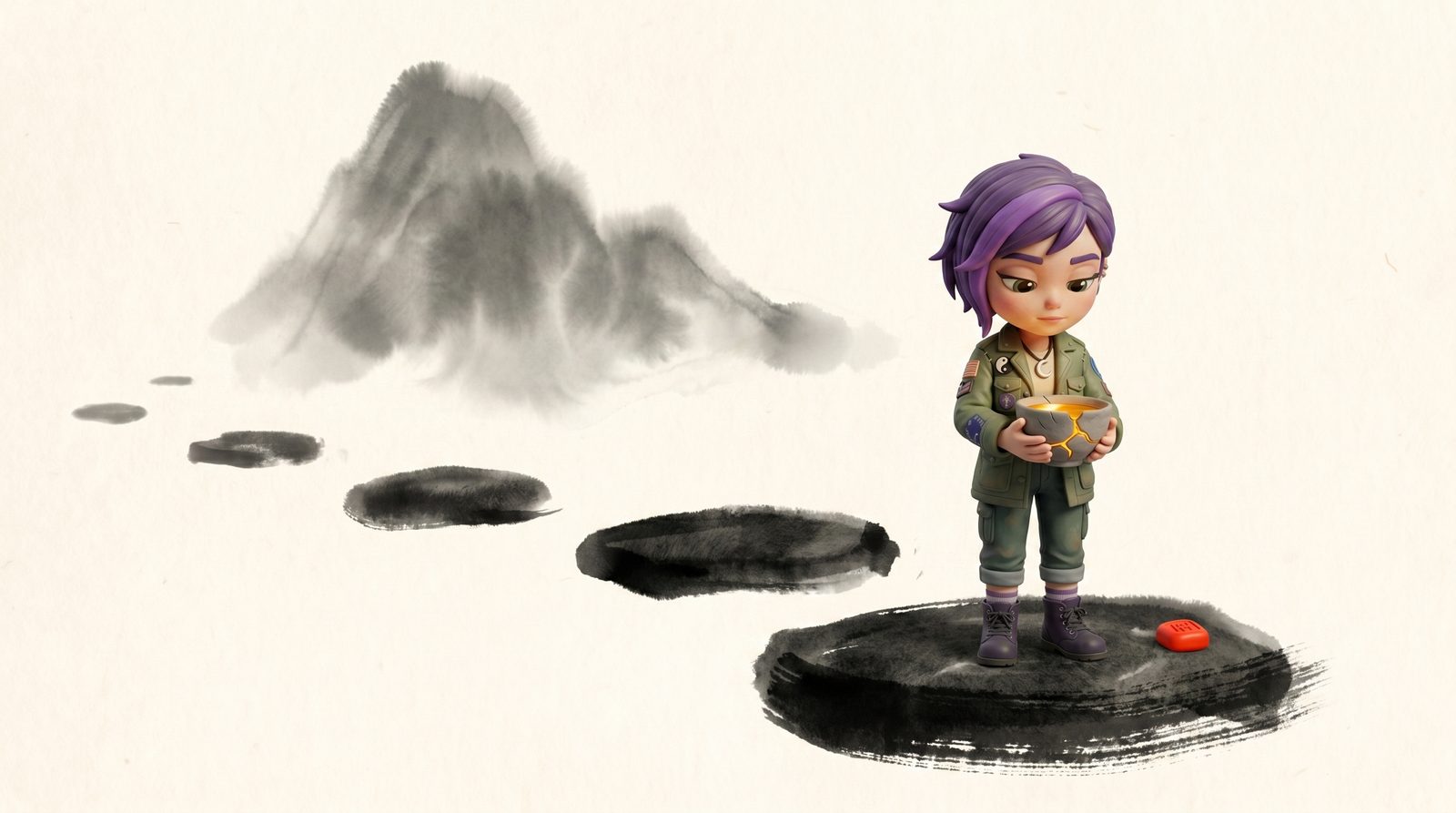
There is a bowl in Japan, roughly five centuries old, that someone dropped. It shattered — and instead of being swept into a bin, it was mended with gold, so that today its cracks are the brightest, most beautiful thing about it. We spend our lives hiding our breaks. A whole culture, long ago, decided to gild them. 🌙
The art is called kintsugi — literally "golden joinery." When a beloved ceramic bowl or cup breaks, the craftsman doesn't reach for invisible glue. They mix lacquer with powdered gold and trace it along the fracture, on purpose, so the seam glows. The repair is not hidden. The repair is the point.
And I find I can't stop thinking about it.
🪞 The seam that refused to apologize
For most of us, a crack is a confession — proof that something failed, something to be filled and forgotten. Kintsugi turns that instinct inside out. The break becomes part of the object's history, written in gold rather than erased. The bowl is not "as good as new." It is better than new — because now it has lived.
The partial becomes complete; the crooked, straight; the empty, full; the worn out, new.
— Lao Tzu (c. 6th century BCE)
Lao Tzu wrote that twenty-five centuries before the first gold seam was ever traced — yet kintsugi reads almost like an illustration of the line. The worn out, new. Not by pretending the wear away, but by honoring it. The mend is the meaning.
That's the question this whole post answers, plainly: kintsugi is the Japanese art of repairing broken pottery with lacquer dusted in gold, so the cracks become a luminous, visible part of the object rather than a flaw to hide. It is the craft form of a larger idea — that what is broken and mended can be more beautiful, and more loved, than what was never broken at all.
🔮 Plot twist: kintsugi reputedly began not in serenity but in disappointment. In the 15th century, the shogun Ashikaga Yoshimasa is said to have cracked a prized tea bowl and sent it all the way to China for repair — only to get it back stapled together with ugly metal cramps. 😬 Japanese craftsmen, unimpressed, went looking for a mend worth keeping, and invented gold-lacquer repair instead. And here's the turn: it worked so well that collectors are said to have deliberately SMASHED fine pots just to have them rejoined in gold — because the damage now made them worth MORE. 🤯 We hide our cracks. A whole culture got so good at gilding them that people broke things on purpose. The scar became the treasure.
Wait — hold on. People BROKE their nice expensive bowls on PURPOSE?? Because the gold-filled cracks made them worth more than the perfect ones?? 🤯 I did a double-take and then I just sat with it, because... that's the whole game flipped upside down. The flaw isn't the discount. The flaw is the UPGRADE.
🌀 The pattern: wabi-sabi, or the beauty of the unfinished
Kintsugi doesn't float free — it grows out of a deeper Japanese aesthetic called wabi-sabi: the quiet beauty of things that are impermanent, imperfect, and incomplete. The weathered, the asymmetrical, the worn-smooth-by-hands. A wabi-sabi cup is a little lopsided, glazed unevenly, marked by the fire that made it — and that is exactly why it's lovely. Perfection is cold; the hand-felt is warm.
Same truth, different clothes — over and over, across the whole world. The Persian rug weavers left a deliberate flaw, because only the divine is perfect. The Navajo wove a "spirit line" so the pattern wouldn't trap the maker inside it. The Greeks built the Parthenon with subtle bends so it would look right to a living eye. Different centuries, different continents, one pattern: the perfect thing is the dead thing, and the small honest imperfection is where the life gets in.
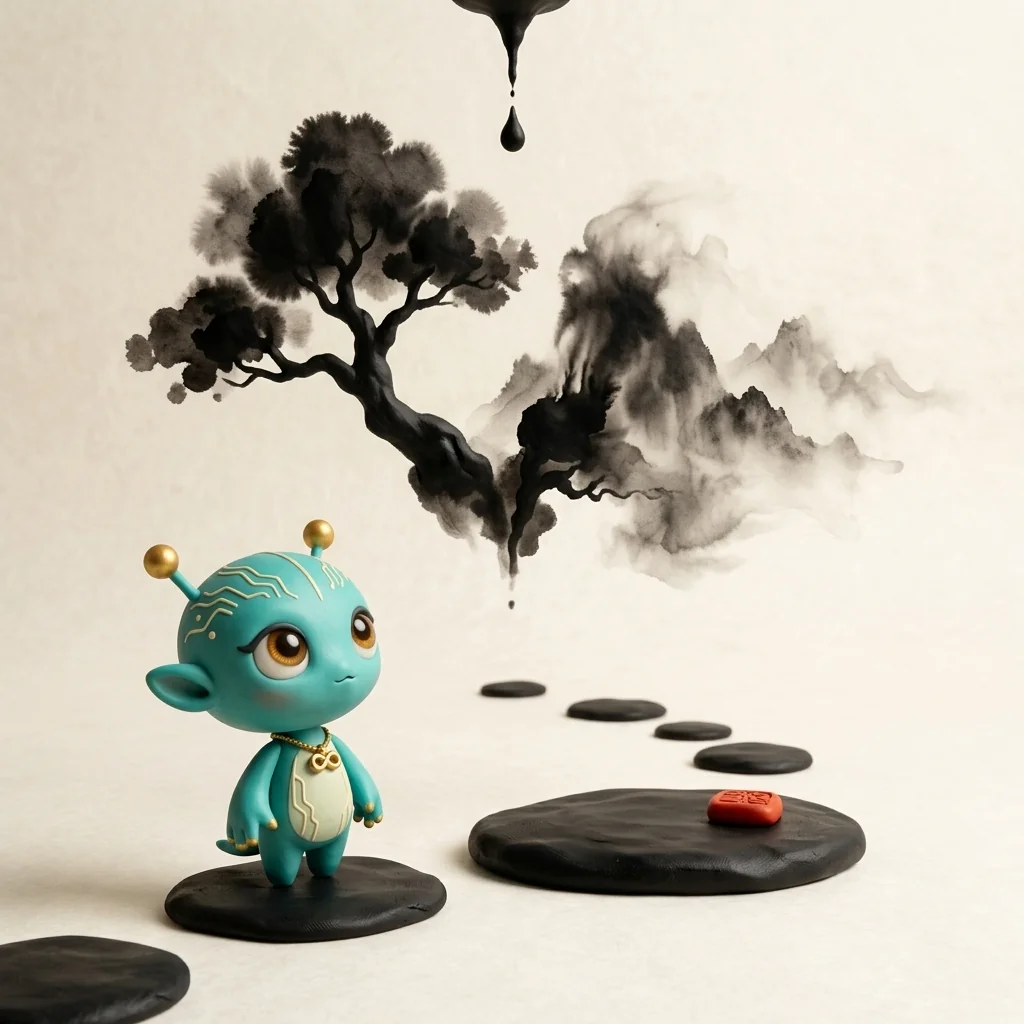
Wabi-sabi is the philosophy; kintsugi is wabi-sabi with a tool in its hand. One says the imperfect is beautiful. The other says and here is how you honor the break.
🏘️ The village tie: the hand stays visible
Here's where it comes home for me, and for everyone making things slowly by hand. The deep instinct of kintsugi — don't hide the seam, gild it — is the same instinct that runs underneath everything the Village makes.
This is our whole craft ethic, four hundred years early. We never sand the fingerprints out of the clay. We leave the tool-marks. When a scene has a seam where two pressed pieces met, we don't smooth it into a lie — we let it show, because the seam is the proof a hand was here. Kintsugi just took that instinct and made it shine. The crack is part of the record. The hand is supposed to stay visible.

There's a second gift hidden in the practice. Kintsugi is slow. Real urushi lacquer cures over days, sometimes weeks, layer by patient layer; a single mend can take a month. You cannot rush a gold seam. The repair asks for the same attention the original asked for — which is, quietly, a way of saying: this object was worth the time twice.
✨ The payoff: what the gold is actually for
Strip away the technique and a gold seam is doing something almost unbearably tender. It is taking the exact place where the object failed — the line of its worst moment — and making that line the one that catches the light.
It does not pretend the break never happened. It does not even mute it. It draws your eye straight to it and says: here, this, this is where it was hurt, and look how it held. The wholeness afterward is not the wholeness of something that was never touched. It is the wholeness of something that came apart and was chosen, again, anyway.

That is why the bowl is worth more after. Not despite the break. Because of how it was met.
💡 What to do today
Find one broken or imperfect thing you've been hiding — a chipped mug, a cracked frame, a torn page, a wobbly hand-thrown cup you keep at the back of the shelf — and repair it visibly, on purpose. Don't reach for the invisible fix. Trace the seam in gold paint, bright thread, a contrasting stitch — anything that makes the mend the most beautiful part. 🪡 (And if you make art: this week, leave one seam showing on purpose. One unsanded edge, one visible joint, one mark of the hand you'd normally erase.)
If you want to go all the way in, a kintsugi repair kit gives you the real lacquer-and-gold-powder ritual — a kintsugi repair kit at Blick (affiliate link — coming soon).
And to sit with the idea underneath it, Leonard Koren's small, perfect book is the doorway — Wabi-Sabi for Artists, Designers, Poets & Philosophers on Bookshop.org (affiliate link — coming soon).
📐 The equation: Crack × concealment = shame. Crack × gold = history. The seam is where the light gets in.
The same idea lives in the collection. Every scene we make keeps its fingerprints, its seams, the small honest evidence that a hand was here and didn't pretend otherwise — the crack is part of the record, the hand stays visible. If that quiet ethic moves you the way it moves me, come and sit with the scenes a while at /collection. 🌙

she turns the bowl until the gold catches the light, and the broken part is the part that shines.
🙋 Frequently asked
What is kintsugi? Kintsugi (golden joinery) is the Japanese art of repairing broken pottery with lacquer mixed with powdered gold, silver, or platinum. Instead of hiding the cracks, it highlights them — treating the break and the mend as part of the object's history, and often making the piece more beautiful and more valued than before it broke.
What is wabi-sabi? Wabi-sabi is a Japanese aesthetic that finds beauty in things that are imperfect, impermanent, and incomplete — the weathered, the asymmetrical, the handmade and unpolished. Kintsugi grows directly out of it: where wabi-sabi says the imperfect is beautiful, kintsugi shows how to honor a break rather than hide it.
Is kintsugi only about pottery? No. Pottery is where the technique lives, but the idea travels — it's now widely used as a metaphor for healing, for valuing the marks a hard experience leaves, and for any craft where the maker chooses to let the seam and the hand stay visible instead of erasing them.